When we think about throwing a baseball or softball, most of us picture the arm action: the windup, the cocking, the ball release. But here’s the truth—your arm doesn’t work in isolation. The shoulder and scapula (the wing-like shoulder blade on your back) are the passengers on the engines of the hips and torso behind smooth, efficient, and powerful throwing. If they’re not moving right, everything down the chain suffers—velocity drops, accuracy slips, and injuries pile up.
The Symphony of Motion
Legendary researcher Dr. Irvin M. Korr once said the brain doesn’t think in terms of isolated muscles, but in terms of entire movements—a “symphony of motion.” That’s never more true than with the shoulder. The scapula, humerus (upper arm bone), and even the forearm have to work in tandem with the hips and torso across three planes of motion:
When one piece is locked up, the rest of the chain is forced to compensate. That’s where inefficiency—and injury—creeps in.
The Role of Shoulder Glide
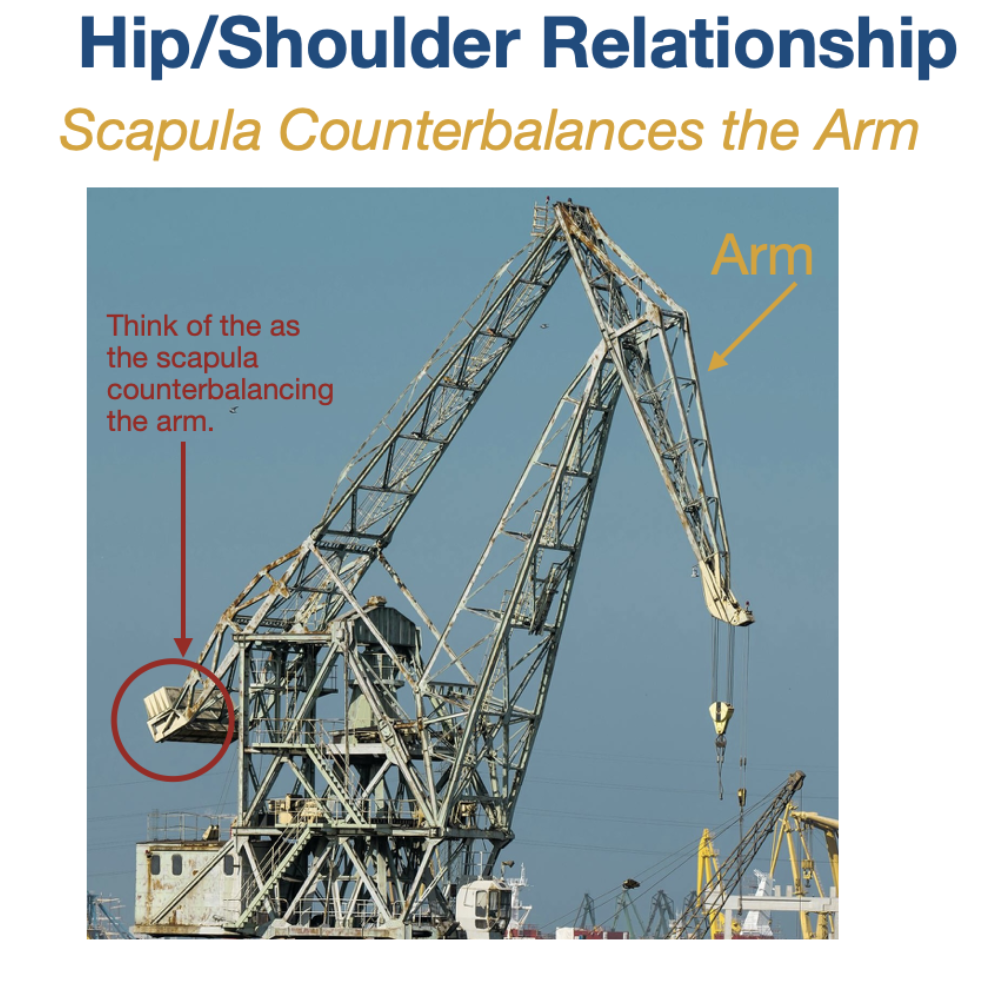
Every time an athlete throws, the head of the humerus must glide smoothly inside the socket—just like the boom of a heavy-machinery crane moving while its counterweight shifts to maintain perfect balance. When the counterweight doesn’t slide into position, the crane becomes unstable, the system strains, and something has to absorb the overload. (Refer to photo of the crane and the counterweight opposite the arm) In the body, that “something” becomes the elbow or shoulder. Smooth shoulder glide is the counterweight system that keeps the arm balanced, powerful, and protected. Here’s the breakdown of glides during throwing:
When glide is restricted—whether from injury, overdevelopment of certain tissues, or just poor mobility—players lose smooth motion. They’re more likely to compensate by yanking the ball, flying open, or straining the UCL.
Why Scapular Mobility Matters
The scapula is the steering wheel of the shoulder. If it can’t move freely—whether from tight tissue, poor posture, or fascial “stickiness”—it limits how the humerus glides. Rounded shoulders, often seen in athletes who spend too much time hunched forward, make things worse. Instead of clean motion, the joint starts running out of room. The result? Impingement, inflammation, and eventually breakdown.
For coaches, this means it’s not enough to just drill arm path or release points. You have to make sure your athletes’ shoulder blades are moving well. When the scapula can upwardly rotate, tilt, and glide properly, the shoulder joint stays healthy and the arm whips through space like it was designed to.
Connecting the Hips and Shoulders
Here’s where things get really exciting. The shoulder doesn’t just work with the scapula—it syncs with the hips across all three planes of motion.
This is the magic of the kinetic chain. A strong hip-to-shoulder connection transfers force efficiently, letting pitchers throw harder with less stress. Break that link, and the shoulder starts working overtime, grinding itself down.
Coaching Takeaways
So how do you, as a coach, bring this science onto the field? Here are some key action points:
Final Word
Throwing is a whole-body event, powered by a symphony of motion that starts at the ground and travels through the hips, shoulders, and finally the arm. If the scapula and shoulder aren’t moving properly, the tune falls apart—and injuries take center stage.
By helping your players develop, hip-shoulder integration, scapular mobility, and shoulder glide, you’ll not only boost velocity and efficiency, but also keep them healthier, longer. And in today’s game—where overuse injuries are all too common—that’s the ultimate win.